The short answer
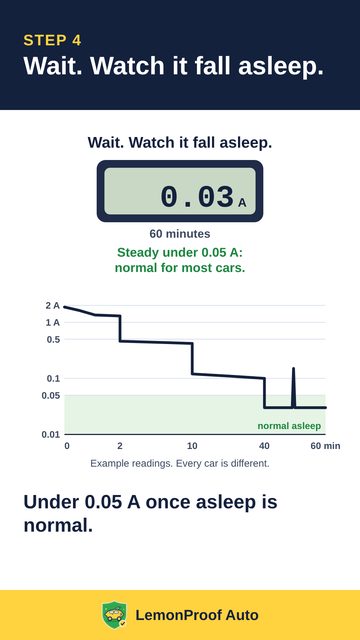
To test for a draw, set the meter to amps, take the negative cable off the battery, and put the meter in between the battery post and the cable. Then wait. The number starts high and falls in steps as the car's computers go to sleep. Most cars settle under 0.05 amps, which is 50 milliamps.
A parasitic draw, a parasitic drain and a battery drain test all mean the same thing: measuring the power the car uses while it's off.
 Watch it in under a minuteOur short video on YouTube
What you need
- A digital multimeter with a 10 A setting.
- A wrench for the battery clamp.
- Clip leads, so the meter stays connected without you holding it.
- Something to set the meter on: a bucket, a box, anything steady. On a tire or bumper it can fall off, and on the hood it can scratch the paint. Your call.
- A charged battery. A weak battery gives a false reading.
- Time. Some cars take up to two hours to fully go to sleep.
Step 1: Set up the meter
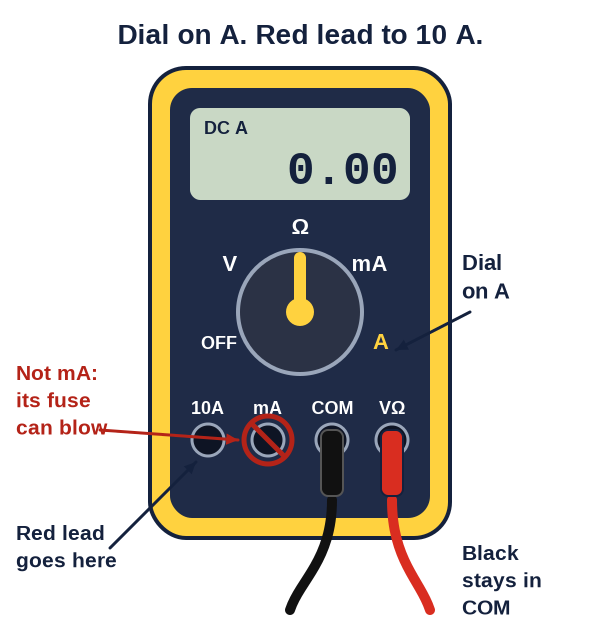
- Turn the dial to amps (A). Not volts, not ohms.
- Move the red lead to the 10 A jack. The black lead stays in COM.
- Not the mA jack. The moment you connect, the draw can be over an amp, and that blows the small fuse inside the meter.
- Start high, on 10 A, even though the number you hope to see is tiny.
Step 2: Find the negative and take it off
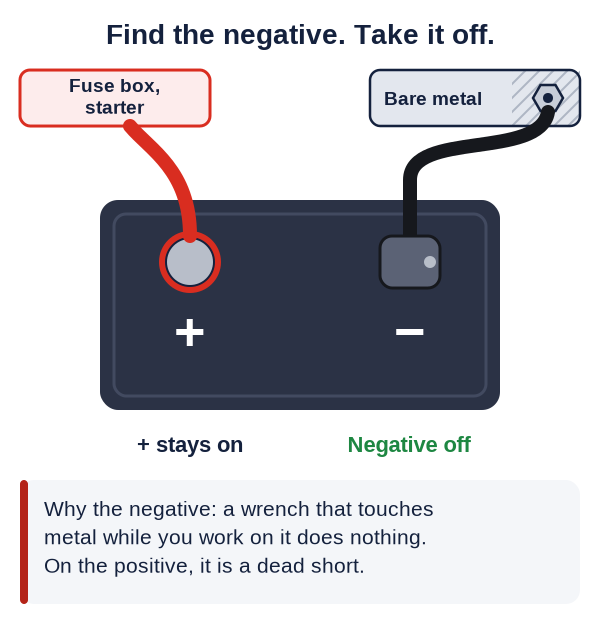
- Shut everything off. Key out and lights off. Roll the windows down, then close the doors, so you can reach in later without opening one.
- Find the negative. It has a − sign, and its cable ends on bare metal: the body or the engine.
- Loosen the negative clamp and lift it off. Leave the positive on.
- Keep the loose cable from touching the post.
Not sure which is which? See which battery terminal is which.
Step 3: Put the meter in between
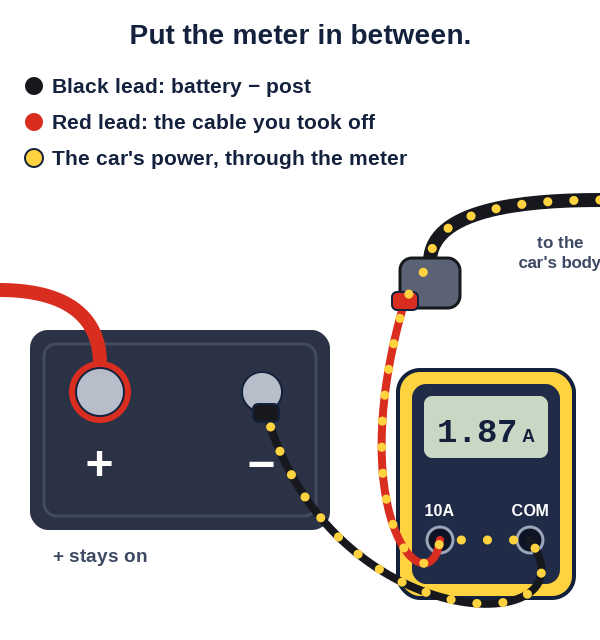
- Black lead to the battery's negative post.
- Red lead to the cable you took off.
- Now all the car's power runs through the meter. Hooked up this way it reads normally. Swap the leads and it shows a minus sign; the number is the same.
Step 4: Wait and watch it fall asleep
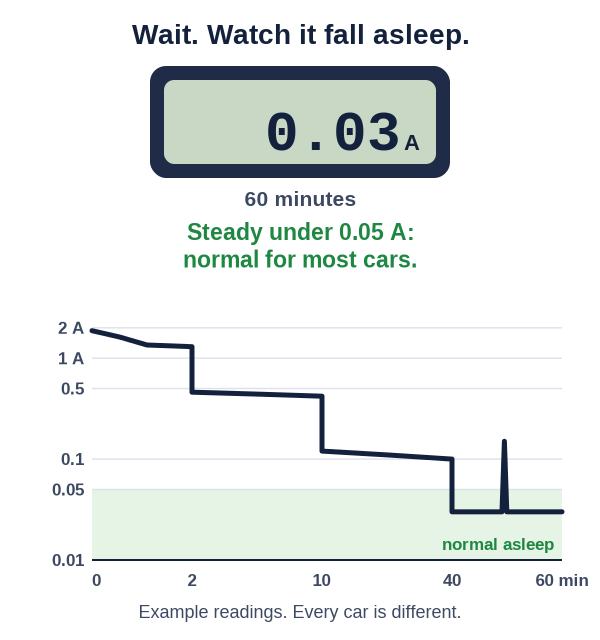
Connecting the meter wakes the car up, so the number starts high. Then it comes down slowly, drops suddenly, holds, and may drop again as each computer goes to sleep.
- Don't open a door or touch the key. That wakes everything up and starts the clock over.
- The car has to be asleep, and the hood counts too. Many cars won't sleep with the hood open. Close it. The meter's wires usually fit through the gap by a headlight.
- Need a door shut that won't stay shut? You can latch it with a screwdriver, but screwdrivers can hurt latches. Do it carefully. Rolled-down windows save you from needing it.
- Keep a push-button key well away from the car.
- A short blip is normal. A computer can wake up for a moment to check in, then go back to sleep.
What the number means
- Under 0.03 A (30 mA)
- What it means: Good.
- 0.03 to 0.05 A
- What it means: Borderline. Normal for some cars with a lot of electronics. Check that car's own spec.
- Over 0.05 A, once asleep
- What it means: Too much. Something is staying awake or staying on.
1 amp is 1,000 milliamps, so 0.05 A is 50 mA. Many meters show two decimal places on the 10 A setting, which is enough to tell.
Why some draw is normal
- Keep-alive memory: what the engine computer has learned, plus the radio presets and the clock.
- The alarm and keyless entry, listening for your key fob.
- Telematics: the connection that lets an app unlock the car or the car call for help.
- Computers talking on the car's network as they shut down, and waking now and then to check in.
- The battery sensor on newer cars, which keeps watch on the battery.
Mistakes that blow a fuse or ruin the test
- Starting on the mA jack. The first rush of current blows its fuse.
- Cranking the engine or turning on the lights with the meter connected. That's far more than the meter can take.
- Opening a door halfway through. The car wakes up and you start over.
- Switching jacks or ranges mid-test. That breaks the circuit for a moment and wakes the car.
- Testing a weak battery. Charge it first.
A pro trick: keep the car asleep
Taking the cable off cuts the power and wakes everything up. Pros clip the meter, or a jumper wire, across the post and the loosened clamp first, then lift the clamp, so the power never cuts out. It's called make before break.
Found a draw? Narrow it down
With the meter still connected, pull fuses one at a time and watch for the number to drop. Or check the tiny voltage drop across each fuse without pulling it, which keeps the car asleep. When the number drops, you've found the circuit. Then find what on that circuit is staying on. See battery keeps dying for the usual suspects.
When you're done, put the cable back on and tighten it. Some cars then need a reset or relearn. See resets and relearns.
Battery drain testing in Charlotte
Rather have us find it? We test for a draw where the car is parked, in Lake Norman, Mooresville, Denver, Lincolnton and Statesville, then narrow it down to the circuit and the part. You get a written estimate before any repair starts.
Get a quote for a battery drain test
Updated November 27, 2026.